

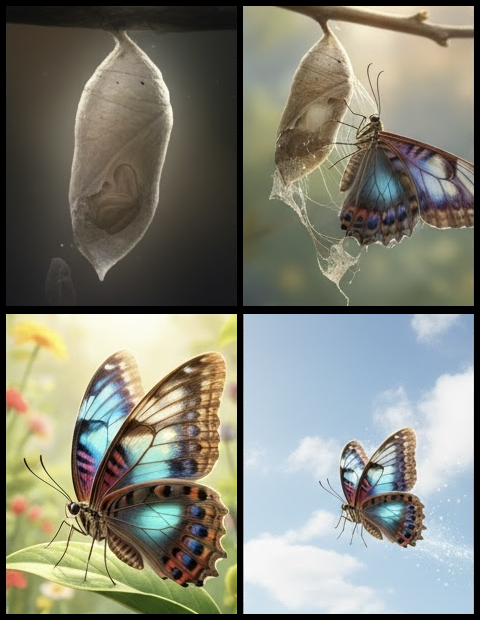
Lately, I have heard rumors that I have been isolating myself. Isolating, huh? XD… I suppose I feel a bit of an obligation to clear things up—or at least to explain what has really been going on.
So, consider this my little case study (lol) on the changes or transformations I have experienced over the past few years.


I have found that journaling helps me organize my thoughts and sort through whatever emotions I am struggling with. Sharing my experience online feels like hitting two birds with one stone—it fulfills my need to reflect and my desire to help others. Perhaps, in telling my story, someone else will find encouragement or perspective for their own path.
You probably already have heard about some of the physical changes—how I lost weight and managed to improve my health—but that is only a small part of the story. What you will see below are the four stages of transformation that I have gone through, not just physically, but also spiritually, intellectually, and emotionally.
When my life started to fall apart years ago—when the relationship I had poured my heart into was crumbling, and the job I had given my sweat, tears, and countless hours to was hanging by a thread—I felt completely uncertain about the future.
The scariest moment came one evening while driving home from work. Out of nowhere, a thought crossed my mind about swerving into oncoming traffic. The shock of that thought terrified me—how could I even think such a thing? But then something happened that I can only describe as divine intervention. As I flipped through the radio stations, I landed on the song "Fear No More" by Building 429. The lyrics hit me deeply, and tears started rolling down my face.
In that moment, something shifted. My mind felt lighter, my negative thoughts began to clear, and my relationship with God felt renewed. It gave me a stronger foundation to start rebuilding my life. From there, I entered what many describe as a “dark night of the soul,” but it was also the beginning of transformation.
___________________
Even though I said it renewed my relationship with God, it is not as if I ever felt completely distant from Him growing up. There were moments when I sensed His presence clearly—times when my prayers felt heard in the most crucial moments.
One memory stands out vividly. When I was a child, my older brother suffered a life-threatening kidney complication. It happened right after a family trip to Baguio, Philippines. On our way back home, we saw a group of helicopters flying overhead. Back then, before smartphones and tablets, kids often passed the time on road trips by looking out the window, counting planes, or watching the scenery. But when we pointed out the helicopters, my brother said he could not see them. “Where? Saan?” he kept asking, confused.
At first, we thought he was joking—but then we realized something was seriously wrong. My mother panicked, slapped his cheeks and pinched him repeatedly to keep him conscious as we rushed him to the nearest hospital. Children were not allowed in the emergency room, so my younger brother and I waited in the car with our dad. We parked near a grotto, and there, the two of us prayed as hard as we could for our brother’s life. I remember crying until I fell asleep—exhausted, but holding onto faith.
By God’s grace, my brother recovered. Despite the severity of his condition, his kidney healed over time, and he never needed dialysis. That miracle became one of the earliest reminders that God was listening—that even in moments of fear and uncertainty, He was there.
After my fiancé left, she also left me with many unanswered questions. That experience pushed me to begin a journey of self-discovery. I wanted to understand why our relationship did not work out, or why our needs and wants seemed so different. The first step I took was learning about personality types. Strangely, even before taking the test, I already had a feeling I was an INFP—perhaps because of my intuitive nature and tendency to connect the dots.
Studying personalities widened my perspective. It helped me see both my strengths and weaknesses and, more importantly, helped me accept my introversion. For as long as I could remember, I have been told that I needed to change—that being introverted was somehow wrong, and that I should be more outgoing. Learning about my personality helped me realize that there was nothing wrong with me. It also explained why, growing up, I often felt like I did not quite fit in with the other boys. I was not interested in sports, I was not competitive, and I lacked the typical “handiness” expected of men. Later, I discovered that I simply possessed traits often associated with women—being intuitive and being a feeler.
I also learned about my tendency to “wait and see” rather than initiate action, which stems from being a perceiver. In my culture, that trait is often misinterpreted as laziness—what we call “Juan Tamad” in the Philippines. But understanding it through the lens of personality theory helped me see that it is really about flexibility and openness to possibilities.
___________________
As an introvert, I discovered that my independence is one of my greatest strengths. I can thrive with minimal social interaction for extended periods, unlike extroverts who draw energy from others. I also learned that introverts often rely more on long-term memory than short-term memory, which can cause a delay when speaking but not when writing. Once I accepted my introversion, I began to monitor my “social battery”—learning to say no when I felt drained and to seek solitude to recharge. One book that resonated deeply with me was The Secret Lives of Introverts by Jenn Granneman.
As an intuitive, I came to understand my struggle with the small details. I remember my mom often scolding me for missing patches when mowing the lawn. She probably thought I was being lazy, but really, my mind was focused on the big picture. While sensors tend to notice the fine details—the “trees”—intuitives are more attuned to the “forest.” We zoom out to see patterns and connections, but that means we sometimes overlook specifics. Intuitives excel at idea generation, connecting the dots, and relying on intuition. Interestingly, intuition has long been associated with women—think of phrases like “a woman’s intuition.” But these traits are not gender-bound; many men, like myself, are intuitives too, just as many modern women are now identified as sensors, excelling in hands-on or detail-oriented work (e.g., car repair or being a mechanic).
As a feeler, I realized why competition never appealed to me. Sports did not excite me—not because I disliked physical activity, but because I lacked the drive to compete. Sometimes, I even empathized with my opponent and found myself going easy on them. Feelers, I learned, are deeply empathetic and often put others’ needs before their own, which can make them vulnerable to being taken advantage of.
Finally, as a perceiver, I came to appreciate my love for flexibility and spontaneity. I find comfort in keeping my options open and joy in unplanned moments. When traveling, I prefer having a free day without a strict itinerary. Unlike my family, I do not get upset when plans change; in fact, I often find it refreshing. Still, I have had to adapt to a world that values structure and planning. Over time, I have developed enough “judging” tendencies that my perceiving/judging ratio is now almost even—51/49. Perhaps that’s why, even as an INFP, I sometimes show traits more typical of an INFJ, like the so-called “INFJ door slam.”
Through this journey, I have learned to see myself more clearly—to understand that my differences are not flaws, but facets of a unique personality. Accepting who I am has been one of the most freeing and transformative experiences of my life.
After watching a few videos on YouTube about personality types, the algorithm began recommending content about emotions. That is how I discovered a creator named Einzelgänger—and I can’t overstate how profoundly his videos have influenced my emotional growth.
Through his content, I learned the value of forgiveness, the art of being flexible like water, the strength found in silence, the peace that comes from minimalism, and the reasons so many of us experience burnout.
Here are some of my favorite videos from him:


Just as the YouTube algorithm once led me to explore emotions and philosophy, it eventually guided me toward the world of health.
To be honest, I did not set out with a specific plan. I was not searching for a particular diet or lifestyle—I simply followed my intuition. Somehow, within the first few seconds of a video, I could tell whether the creator was genuine and trustworthy.
One of the channels that truly resonated with me was What I’ve Learned by Joseph Everett. His videos opened my eyes to how fat is not the enemy, how saturated fat and salt have been unfairly demonized, why counting calories often fails, and how fasting can transform one’s health and mindset. Some of my favorite videos from him include:


Over time, I also discovered other insightful channels such as:
Each of them has contributed to my understanding of health and helped me make meaningful improvements in my own life.
So, have I really been isolating myself? Not exactly. I’ve simply become more aware of my needs. The modern world constantly bombards us with stimulation—endless information, notifications, messages, and noise. Our attention is constantly being pulled in every direction.
For an introvert like me, that overload can be exhausting. To protect my energy, I’ve learned to set boundaries around what drains me. I’ve also made space for stillness, embracing the kind of quiet idleness that often fuels creativity.
That said, it’s all still a work in progress. I’m still figuring out how much social interaction feels right for me—enough to stay connected, but not so much that it leaves me drained.
Anyway, thanks for reading!
___________________
Copyright Disclaimer
This website shares content created by third parties for educational and informational purposes only. All rights to the original content belong to their respective owners. I do not claim ownership, nor do I profit directly from these materials.
If you are the copyright holder of any content featured here and wish to have it removed, please contact me and I will promptly take it down.
Copyright © 2025 Kristoffer Sayoc